

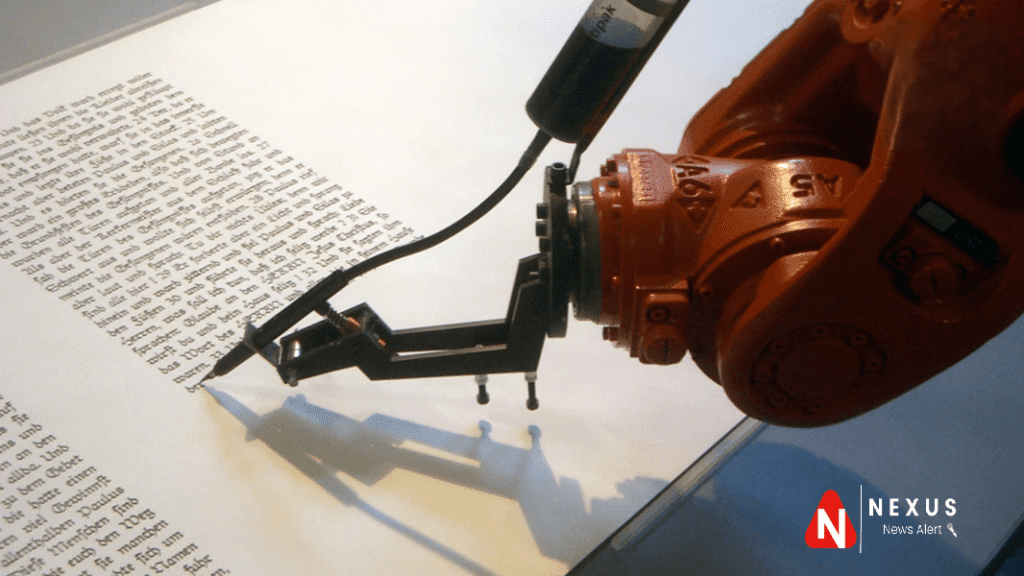
Nexus News Alert | New Delhi, 4 June 2026 — The announcement of the Commonwealth Short Story Prize winners has sparked a major debate around the use of AI Detection Tools and the growing presence of AI-generated content in creative writing. Allegations that some winning entries showed signs of being produced by artificial intelligence have put both writers and detection technology in the spotlight.
The controversy began after Granta magazine announced the regional winners. Social media users quickly flagged several stories using tools like Pangram, claiming they were AI-generated. This incident has raised broader questions about how reliable AI Detection Tools really are and whether they can accurately distinguish between human and machine-written text.
Also Read : OpenAI Acquires Weights.gg: Voice-Cloning Startup Bought
The Commonwealth Short Story Prize Controversy
The prize, awarded across five regions, saw immediate backlash after winners were declared. Stories by writers from the Caribbean, Asia, and Canada-Europe were accused of being AI-assisted. While two winners were cleared as fully human-written, the others faced heavy scrutiny.
Indian writer Sharon Aruparayil strongly denied using AI, stating no tools were involved at any stage. The episode has highlighted the increasing role of AI in writing and the challenges in verifying authenticity.
How AI Detection Tools Work
AI Detection Tools primarily use machine learning models trained on large datasets of both human and AI-generated text. These models look for statistical patterns that are common in AI writing, such as:
Also Read : How to Get Free Ultron Cybernetic Drip Skin in Marvel
- Frequent use of em dashes
- Overuse of certain words like “delve” or “imperative”
- Formulaic structures (e.g., “Not X, but Y”)
- Neat conclusions without introducing new ideas
- Bullet-point style organisation
Tools like Pangram claim very low false positive rates (around 0.01%), but experts say no detector is 100% accurate.
Limitations of Current AI Detection Tools
According to Danish Pruthi, Assistant Professor at IISc Bengaluru, these tools face several challenges:
- Short texts are harder to classify due to insufficient patterns
- Highly structured or “low-entropy” content (like lists or code) confuses detectors
- Light editing of AI-assisted text can lead to false flags
- Models may over-rely on training data patterns that don’t always hold
Pruthi emphasised that using general AI chatbots like ChatGPT or Claude for detection is unreliable, as they are not specifically trained for this task.
Impact on Writers and Publishers
The controversy has sparked wider discussions about transparency in writing. Nobel laureate Olga Tokarczuk faced criticism for using AI in research (though she clarified it wasn’t for writing). Publishing professionals stress the need for clear disclosure when AI is used.
Jane Friedman, a veteran publishing expert, noted that while AI tools are here to stay, the industry needs better standards for responsible use. She warned against over-reliance on detectors, calling for a more nuanced understanding of human-AI collaboration.
The Bigger Picture: AI in Creative Fields
This episode is part of a larger shift. AI is increasingly being used for research, drafting, and editing across literature, journalism, and academia. While it offers efficiency, it also raises questions about originality, authorship, and trust.
Experts believe the solution lies not in banning AI but in developing better detection methods and ethical guidelines for its use.
10 FAQs on AI Detection Tools
Q1. What are AI Detection Tools?
A: Software that analyses text to determine if it was written by a human or generated by AI.
Q2. How accurate are current AI detectors?
A: They are improving but not perfect. False positives and negatives still occur, especially with short or edited text.
Q3. Which tool was used in the Commonwealth Prize controversy?
A: Pangram was widely cited by users flagging stories.
Q4. Can AI detectors be trusted completely?
A: No. Experts recommend using them as supporting evidence rather than definitive proof.
Q5. Why is AI-generated text hard to detect?
A: Advanced models mimic human patterns very closely, especially in structured writing.
Q6. Should writers disclose AI use?
A: Transparency is increasingly expected in publishing and journalism.
Q7. Are plagiarism detectors the same as AI detectors?
A: No. Plagiarism checks for copied content, while AI detectors look for machine-generated patterns.
Q8. Can ChatGPT detect AI-written text?
A: It is not reliable for this purpose as it is not specifically trained for detection.
Q9. What should publishers do?
A: Combine multiple tools, ask for process disclosure, and develop clear AI usage policies.
Q10. Will AI replace human writers?
A: Unlikely. AI is seen as a tool to assist rather than replace creative work.
Nexus News Alert Verdict
The Commonwealth Short Story Prize controversy has brought the limitations and importance of AI Detection Tools into sharp focus. While AI offers exciting possibilities for creativity, it also demands greater transparency and better verification methods. As the line between human and machine writing blurs, the publishing world must adapt with clear ethical standards.
This episode serves as a timely reminder that technology should support, not undermine, authentic creative expression. The coming years will likely see more sophisticated tools and guidelines to navigate this new reality.
Stay tuned with Nexus News Alert for more updates on AI in writing, technology controversies, Commonwealth Short Story Prize developments, and all major stories at the intersection of art and artificial intelligence.