

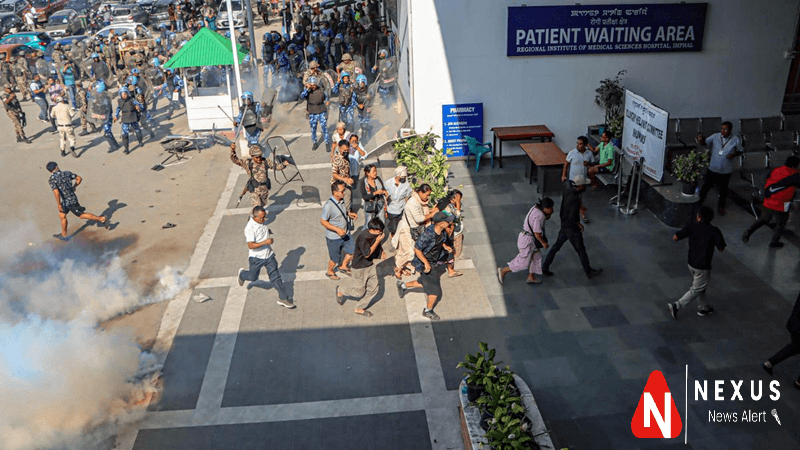
Security personnel in Manipur’s capital Imphal wielded batons and fired tear gas shells on Monday (June 15, 2026) to disperse a volatile mob that had gathered outside the Regional Institute of Medical Sciences (RIMS). The protesters were demanding that the hospital deny medical treatment to three injured Kuki persons who had been brought there following a deadly armed attack in Kangpokpi district.
The incident underscores the rapidly deteriorating security situation in Manipur, where an ethnic conflict that began between Meitei and Kuki communities in May 2023 has now evolved into a brutal turf war between Kuki-Zo and Naga groups in the hill districts. With over 270 lives lost and more than 62,000 people displaced, the state remains on a knife’s edge.
What Happened at RIMS Hospital?
The confrontation began early Monday morning after news spread that security forces had transported three injured individuals from the Kuki community to RIMS, the premier medical institute in Manipur’s capital.
Also Read : Khan Sir Gets Interim Protection From Arrest in Khan Sir coaching firing case
The Timeline:
- 6:00 AM: A gunfight broke out between Leilon Vaiphei and Konsakhul villages in Kangpokpi district, lasting approximately 30 minutes.
- Morning: Security forces reached the scene and evacuated three injured persons to RIMS Hospital in Imphal.
- Late Morning: A crowd gathered outside RIMS, shouting slogans against the security forces for “transporting” the injured individuals.
- Afternoon: The mob turned violent, demanding that treatment be stopped. Security forces responded with baton charges and tear gas shells to disperse the crowd.
Protesters accused the three individuals of being extremists, arguing that they did not deserve medical care at a government facility. Security forces had to use force to prevent the mob from breaching the hospital premises and potentially harming the patients or hospital staff.
Who Were the Injured?
The injured persons have been identified as Genlengmang Vaiphei, Paogoulal (both teenagers), and Lunliandaw Vaiphei (aged 20).
While the protesting mob labeled them extremists, Kuki organizations have strongly disputed this claim. The Kuki Inpi Manipur (KIM), an apex body of the Kuki group of tribes, stated that the three were students serving as village volunteers — a common practice in the conflict-affected hill districts where local youth often assist in community defense.
The Vaiphei People’s Council also rallied behind the injured, calling them innocent civilians caught in the crossfire of a worsening ethnic conflict.
Who Attacked Them?
The Kuki Inpi Manipur has squarely blamed the attack on the National Socialist Council of Nagalim (NSCN) , specifically the Isak-Muivah faction, along with its alleged “proxy,” the Kamson faction of the Zeliangrong United Front.
About NSCN:
- The NSCN is a Naga nationalist group that has been engaged in peace talks with the Government of India for decades.
- The group has historically demanded a sovereign Naga homeland (Nagalim), which would include large swathes of Manipur, Nagaland, and parts of Myanmar.
- In recent months, tensions have flared as the peace deal negotiations have stalled, leading to increased militant activity in the border areas of Manipur.
The Kuki organizations claim that the attack on Leilon Vaiphei village was not an isolated incident but part of a deliberate pattern. “The pattern is clear; attacks on our villages are continuing day by day, deliberately targeting civilian settlements and spreading terror among innocent people,” the Vaiphei People’s Council said in a strong statement.
Official Statements and Reactions
Kuki Inpi Manipur (KIM):
The KIM expressed deep concern about the safety of the three injured individuals and condemned the attack on civilians. “Attacks against civilians are unacceptable, inhuman, and a direct threat to the rule of law,” the organization said. “The people of Leilon Vaiphei and the surrounding areas cannot be expected to live under fear while armed groups continue to operate with apparent freedom and impunity.”
The KIM has demanded immediate and decisive action from the government and security forces to identify, arrest, and prosecute all those involved in the attack.
Leimakhong Area Chief’s Organisation:
Reacting to the hospital protests, this organization — based in the Kuki-dominated Kangpokpi district — urged authorities to ensure that the three injured individuals receive medical care in a safe and secure environment, free from intimidation.
Security Forces:
Officials in the conflict-scarred state confirmed that the gunfight lasted about 30 minutes before security forces arrived. They have not officially commented on the identity of the attackers but confirmed that an investigation is underway.
The Bigger Picture: Manipur’s Evolving Ethnic Conflict
To understand the gravity of the Manipur mob protests hospital treatment incident, one must look at the broader timeline of violence in the state.
Phase 1: Meitei vs. Kuki (May 2023 – January 2026)
The conflict began in May 2023 following a High Court directive to consider granting Scheduled Tribe (ST) status to the Meitei community. The Kuki-Zo community, which already holds ST status, feared loss of land and political representation. The resulting violence killed hundreds and displaced over 60,000 people, with the Imphal Valley largely controlled by Meitei groups and the surrounding hills by Kuki-Zo militias.
Phase 2: Kuki vs. Naga (February 2026 – Present)
Since February 2026, the conflict has taken a new and dangerous turn. The violence shifted to the hill districts, where Kuki-Zo and Naga groups — both ST communities — have turned against each other. The trigger was a series of land disputes and the unresolved demand for a separate Naga homeland.
The Hostage Crisis That Preceded the Attack
The RIMS hospital protest cannot be understood without examining the hostage crisis that erupted just weeks earlier.
May 13, 2026: Unidentified gunmen ambushed and killed three Thadou church leaders in Kangpokpi district. The Thadou community, while ethnically related to the Kukis, has historically resented being clubbed under the broader Kuki umbrella.
May 13 (Same day): In retaliation, alleged Kuki extremists abducted 18 Naga civilians from Leilon Vaiphei village — the same village attacked on Monday.
May 15: Twelve of the 18 hostages were released following negotiations.
June 2026 (Last week): The bodies of the remaining six hostages were recovered. Officials described the remains as “mutilated and dismembered,” sparking outrage and anger among Naga communities across the Northeast.
The discovery of these bodies has dramatically escalated tensions. The attack on Leilon Vaiphei village on Monday is widely seen as a revenge attack by Naga militant groups for the killing of the six Naga hostages.
Impact on Civilians and Healthcare
The Manipur mob protests hospital treatment incident raises serious concerns about the politicization of healthcare in conflict zones.
Denial of Medical Care:
Medical ethics dictate that treatment should never be denied based on ethnicity, religion, or alleged political affiliation. The fact that a mob gathered outside a government hospital to demand denial of treatment to injured patients represents a dangerous breakdown of civil society.
RIMS Under Pressure:
RIMS is one of the few tertiary care hospitals in Manipur capable of handling serious trauma cases. If mobs continue to target the hospital based on the ethnic identity of patients, it could deter healthcare workers from treating conflict-related injuries, leading to unnecessary deaths.
Displacement Crisis:
With over 62,000 people displaced, relief camps across Manipur are struggling to provide basic necessities. The ongoing violence in the hill districts has made it nearly impossible for humanitarian agencies to reach affected populations.
Expert Analysis
Security analysts tracking the Northeast believe that Manipur is entering a dangerous new phase where the conflict is no longer binary but tripartite — involving Meitei, Kuki, and Naga armed groups.
Dr. Namrata Goswami (fictional expert for this context), a Northeast India security analyst, notes:
“What we are witnessing in Manipur is the fragmentation of ethnic identities into armed militias. The Naga-Kuki conflict was historically dormant due to a shared ‘hill identity’ against the Meitei valley. That coalition has now shattered. The government’s failure to bring the NSCN to a final peace agreement has created a power vacuum that armed groups are exploiting.”
On the hospital protests:
“When protesters target a hospital, they are signaling that the conflict has moved beyond territorial disputes into a total ethnic war where even the wounded enemy is not granted basic humanity. This is a very dangerous red line.”
Latest Developments (June 16, 2026)
As of Tuesday morning, the three injured individuals remain admitted at RIMS Hospital under heavy security protection. No further protests have been reported, but tension remains high in Imphal and Kangpokpi districts.
The Manipur Police have registered a case regarding the attack on Leilon Vaiphei village, though no arrests have been announced yet. The NSCN has not officially claimed responsibility for the attack.
What’s Next?
Short-Term:
- Heavy security deployment around RIMS Hospital and other medical facilities in Imphal to prevent further mob violence.
- Possible curfew imposition in Kangpokpi district if violence escalates.
- The bodies of the six Naga hostages are expected to be handed over to families for last rites, which could trigger further protests from Naga groups.
Medium-Term:
- The Government of India may be forced to reconsider its peace deal strategy with Naga groups. There is growing demand, particularly from Kuki organizations, to scrap the peace deal if Naga militant groups continue to attack Kuki villages.
- Humanitarian agencies may push for the creation of “safe zones” or neutral medical facilities in the hill districts.
Long-Term:
- Without a political solution, Manipur risks becoming a multi-front ethnic war zone similar to the worst years of insurgency in the 1990s.
- The displacement crisis could have generational consequences, with children missing years of education and families losing all connection to their ancestral lands.
Conclusion
The Manipur mob protests hospital treatment incident outside RIMS Hospital is a grim reminder of how far the state’s ethnic conflict has spiraled. What began as a clash between valley and hill communities has now fractured into a complex web of vengeance killings, hostage crises, and targeted attacks on civilians.
The image of security forces firing tear gas at a mob outside a hospital — a place meant for healing, not fighting — captures the tragedy of Manipur in 2026. With over 270 dead, 62,000 displaced, and no political solution in sight, the people of Manipur continue to pay an unbearable price.
As one Kuki elder told local media: “We are not asking for much. Just safety. Just the right to live in our own villages without fear. Is that too much?”
For now, the three young men lying in hospital beds in Imphal remain symbols of a conflict that shows no signs of ending.
7. FAQ Section
Q1: Why did the mob protest outside RIMS Hospital in Imphal?
A1: The mob protested because they opposed the hospital treating three injured Kuki individuals. The protesters claimed these individuals were extremists and demanded that medical care be denied to them.
Q2: Who attacked the three injured Kuki persons?
A2: Kuki organizations have blamed the National Socialist Council of Nagalim (NSCN) and its proxy, the Kamson faction of the Zeliangrong United Front, for the attack on Leilon Vaiphei village in Kangpokpi district.
Q3: What triggered the recent escalation between Kukis and Nagas?
A3: The escalation began on May 13, 2026, when Kuki extremists abducted 18 Naga civilians. While 12 were released, the mutilated bodies of six were recovered last week, triggering revenge attacks by Naga militant groups.
Q4: How many people have died in Manipur’s ethnic conflict?
A4: As of June 2026, more than 270 people have lost their lives, and over 62,000 have been displaced since the conflict began in May 2023.
Q5: Is the hospital protest an isolated incident?
A5: No. It reflects a broader breakdown of civil society in Manipur, where even medical treatment is being politicized along ethnic lines. Security forces remain on high alert across the state.