

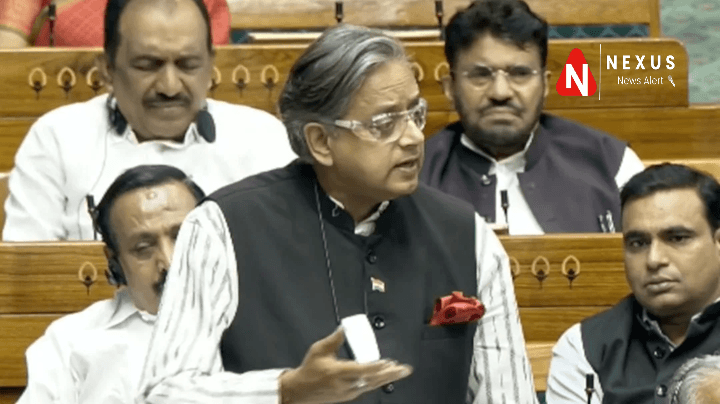
Congress MP Shashi Tharoor delivered one of the sharpest speeches of the ongoing Parliament session on April 17, 2026, taking the government head-on over its decision to tie the long-awaited Women's Reservation Bill to the contentious delimitation exercise. Tharoor called the move a "political demonetisation" — a reckless, hasty action with sweeping consequences — and urged the government to separate the two issues immediately.
Speaking on the Constitution (One Hundred and Thirty-First Amendment) Bill, 2026 in the Lok Sabha, Tharoor made it unambiguously clear: Congress supports the Women's Reservation Bill and will vote for it today. But the delimitation exercise, in his view, needs months of deliberation — not a rushed vote.
What Is the Women's Reservation Bill Being Debated Today?
The Constitution (131st Amendment) Bill, 2026 is a landmark piece of legislation that proposes three sweeping changes to India's electoral architecture:
- Expansion of Lok Sabha seats from the current 543 to a maximum of 850 (815 from states, 35 from union territories) — aligned with the new Parliament building's seating capacity.
- Triggering the Women's Reservation Act of 2023 — which had already guaranteed 33% reservation for women in Lok Sabha and State Assemblies, but tied its implementation to a post-Census delimitation.
- Conducting delimitation based on the 2011 Census — a provision that has ignited fierce opposition from southern states.
Also Read : UK Rewilding: 15m Oysters Released
Two companion bills were also introduced on April 16, 2026: the Delimitation Bill, 2026 and the Union Territories Laws (Amendment) Bill, 2026.
The core controversy: the government has bundled women's reservation and delimitation into a single legislative package — making it impossible to pass one without the other.
Tharoor's Demonetisation Warning: What He Actually Said
Addressing the Lok Sabha, Tharoor drew a direct and deliberate comparison between delimitation and the 2016 demonetisation — an overnight, top-down decision that sent shockwaves through the Indian economy.
"The Prime Minister says the Government has bought Nari Shakti a gift of justice. But he has wrapped it in barbed wire," Tharoor said, arguing that tethering the Women's Reservation Bill to delimitation amounts to holding women's political rights hostage to one of the most complex and divisive administrative exercises in Indian democratic history.
Also Read : Lakers vs Wizards Highlights 2026: Watch LeBron’s
His message was clear: "Pass the Women's Reservation Bill today — we will support it. As for delimitation, let us defer it. Give women their reservation... please consider the larger interest of the country."
Tharoor's demonetisation analogy was pointed: just as demonetisation was rushed through without adequate deliberation and caused massive disruption, he warned that a hurried delimitation would tear at the federal fabric of India in ways that could take decades to repair.
The Federal Fault Lines: Why Southern States Are Alarmed
Tharoor outlined three major fault lines in the current delimitation proposal — each of which strikes at the heart of Indian federalism:
1. Large States vs. Small States
Delimitation based on population will disproportionately favour the more populous northern states while reducing the political voice of smaller states in the south and northeast.
2. States That Controlled Population vs. States That Did Not
This is the sharpest edge of the debate. States like Tamil Nadu and Kerala have successfully implemented national population control goals over decades. Under a population-proportional delimitation formula, they stand to lose Lok Sabha seats — despite having done exactly what the national government asked of them.
According to analysis by PRS Legislative Research, if delimitation proceeds on current population figures, Tamil Nadu's Lok Sabha seats would fall from 39 to 32 and Kerala's from 20 to 15. Meanwhile, Uttar Pradesh would rise from 80 to 89, Bihar from 40 to 46, and Rajasthan from 25 to 30.
Tharoor captured the absurdity pointedly: "In delimitation, states which have failed to control population will be rewarded with greater political weight."
3. The 50% Formula and Its Legal Fragility
Tharoor also took direct aim at Home Minister Amit Shah's proposal of a 50% reservation formula, calling it "a precarious political statement" that has no legislative backing. "It is not promised by the legislature," he stated flatly.
The Constitutional Stakes: What Legal Experts Say
The Women's Reservation Bill and delimitation together represent the most significant reshaping of Indian parliamentary democracy since 1971. The constitutional tension is real and multi-layered:
- Article 81 mandates that Lok Sabha seats be distributed in proportion to population — the "one person, one vote, one value" principle. This directly conflicts with political assurances to preserve existing seat proportions for southern states.
- The new Bills lower the threshold to trigger delimitation from a constitutionally-mandated process to one that can be activated by a simple parliamentary majority — giving any ruling coalition the power to time delimitation for political advantage.
- The 2023 Women's Reservation Act had already guaranteed 33% reservation in law, but its activation was deliberately deferred pending a delimitation. Critics argue this was always a delay tactic, and the current bundle of bills confirms those fears.
Congress's Position: Support the Bill, Reject the Bundle
Tharoor made Congress's position absolutely clear on the floor of the House:
- Congress fully supports the Women's Reservation Bill and will vote in its favour.
- Congress opposes bundling the Women's Reservation Bill with delimitation.
- Delimitation must be deferred and subjected to wide-ranging consultation with all states, political parties, and constitutional experts before being taken up.
This position puts Congress in an interesting strategic spot — supporting a bill the government can claim credit for, while simultaneously drawing a red line on the process and the federal implications of delimitation.
Why the Demonetisation Comparison Resonates
Tharoor's comparison is not merely rhetorical. It carries a precise political charge. Demonetisation in 2016 was:
- Announced overnight, without parliamentary debate
- Implemented with tremendous confidence about short-term pain and long-term gain
- Ultimately criticised as having caused disproportionate disruption to ordinary citizens while failing to deliver its stated goals
Delimitation, Tharoor argues, risks the same pattern: a sweeping structural change, rushed through on the back of a morally unimpeachable cause (women's reservation), without adequate deliberation of the damage it could cause to federalism, regional equity, and the constitutional compact between states and the Centre.
What Happens Next?
A 15-hour debate on the Women's Reservation Bill and the delimitation bills has been scheduled in Lok Sabha, with a vote expected as early as tomorrow. The political temperature is high:
- Southern states — including Tamil Nadu, Kerala, Karnataka, and Andhra Pradesh — have raised strong objections through their representatives in both houses.
- The Opposition is broadly united in demanding that the Women's Reservation Bill be separated from the delimitation package.
- The government has so far shown no indication of decoupling the two, arguing that the entire package is necessary for a coherent restructuring of Parliament.
At a Glance: Key Numbers in the Delimitation Debate
| State | Current Lok Sabha Seats | Projected Seats (Post-Delimitation) | Change |
|---|---|---|---|
| Tamil Nadu | 39 | 32 | −7 |
| Kerala | 20 | 15 | −5 |
| Uttar Pradesh | 80 | 89 | +9 |
| Bihar | 40 | 46 | +6 |
| Rajasthan | 25 | 30 | +5 |
| Total (Lok Sabha) | 543 | Up to 850 | +307 |
FAQ: Women's Reservation Bill and Delimitation 2026
Q: What is the Women's Reservation Bill? The Women's Reservation Bill (enacted as the 106th Amendment in 2023) guarantees 33% reservation for women in Lok Sabha and State Legislative Assemblies. Its implementation was tied to completion of a delimitation exercise — which is now being triggered through the 131st Amendment Bill, 2026.
Q: Why is Tharoor comparing delimitation to demonetisation? Tharoor used the demonetisation analogy to warn against rushing a transformative and potentially disruptive policy change without adequate deliberation — just as demonetisation was launched overnight with significant unintended consequences.
Q: Why are southern states opposing the delimitation? States like Tamil Nadu and Kerala successfully controlled population growth over decades. Under a population-proportional delimitation, they would lose Lok Sabha seats to northern states that have larger populations — effectively penalising states for achieving a national policy goal.
Q: Does Congress support the Women's Reservation Bill? Yes. Congress has explicitly stated it will vote in favour of the Women's Reservation Bill. Its objection is specifically to the bundling of women's reservation with the delimitation exercise.
Q: What is the 50% formula Amit Shah proposed? Home Minister Amit Shah proposed that 50% of Lok Sabha seats be reserved for women. Tharoor characterised this as a political statement without legislative foundation.
Key Takeaway
The debate over the Women's Reservation Bill and delimitation is not simply a political skirmish — it is a constitutional reckoning about the future shape of Indian democracy. The central question Tharoor posed goes to the heart of the matter: why must women's long-overdue reservation be held hostage to one of the most contested and complex exercises in India's federal history? Separating the two, he argued, is not weakness — it is wisdom.