


By Nexus News Alert Desk
Last Updated: 24 June 2026
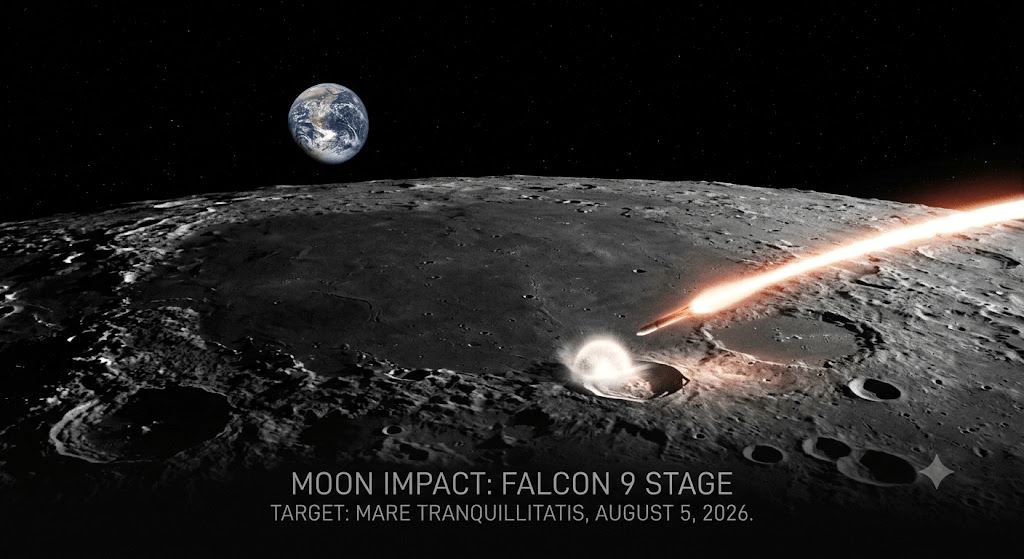
The Moon impact 2026 event has attracted attention after astronomers predicted that a discarded Falcon 9 upper stage may hit the lunar surface on 5 August 2026. The object is not an asteroid, and it does not pose any danger to Earth. It is believed to be leftover rocket hardware from a lunar mission launched in January 2025.
The predicted Moon impact 2026 collision is expected to happen near the edge of the Moon as seen from Earth. Astronomers say the object may strike the lunar surface at high speed and could create a small new crater.
While this event is not dangerous for people, satellites or Earth, it raises an important question: as more countries and private companies send missions toward the Moon, what happens to the leftover hardware?
Also Read : World Brain Tumour Day 2026: Doctors Highlight Early Symptoms
Moon Impact 2026: What We Know So Far
According to available astronomy reports:
- A discarded Falcon 9 upper stage is predicted to hit the Moon.
- The expected date is 5 August 2026.
- The predicted time is around 06:35–06:44 UTC.
- The impact may happen near the lunar limb, close to the Einstein crater region.
- The object may be travelling at about 2.43 km per second.
- The event does not pose any danger to Earth.
- The impact may not be easily visible from Earth.
- Lunar orbiters may later help scientists study the new crater if conditions allow.
The Moon impact 2026 event is therefore more of a space-debris and lunar-science story than a public-safety threat.
Also Read : West Asia War: Israel and Lebanon Agree on Ceasefire as Trump Pushes
What Is Going To Hit The Moon?
The object linked with the Moon impact 2026 prediction is believed to be a Falcon 9 upper stage. A rocket upper stage is the part of a rocket that continues carrying a payload after the lower stage has done its job.
In many Earth-orbit missions, leftover rocket parts later fall back into Earth’s atmosphere and burn up. But some lunar mission hardware can remain in unusual Earth-Moon orbits for months or years.
In this case, the upper stage is believed to have stayed in the Earth-Moon system after helping send lunar spacecraft toward the Moon. Over time, gravity from Earth, the Moon and the Sun shaped its path. Astronomers tracking the object now expect it to collide with the Moon.
Is The Moon Impact 2026 Dangerous?
No. The Moon impact 2026 event is not dangerous for people on Earth. The object is going to hit the Moon, not Earth. It is also not expected to create any risk for ordinary skywatchers.
The Moon has no thick atmosphere like Earth. So objects that hit the Moon do not burn up in the same way meteors burn in Earth’s atmosphere. They reach the surface directly and create craters.
This is why the Moon is covered with impact marks. Over billions of years, asteroids, meteoroids, comets and occasional human-made objects have struck the lunar surface.
Will People See The Impact From Earth?
The Moon impact 2026 event may not be easy to see from Earth. The impact site is expected to be near the Moon’s edge from our view, and the flash may be too small or too faint for ordinary observers.
Some experienced astronomers may try to watch the Moon at the predicted time, but visibility will depend on location, telescope setup, lunar lighting and the exact impact point.
Even if people cannot see the impact live, scientists may still look for the resulting crater later using lunar orbiters.
Why Scientists Care About This Impact
The Moon impact 2026 event may provide a small scientific opportunity. If a new crater forms and is later photographed, scientists can compare before-and-after images of the lunar surface.
Such observations can help researchers understand:
- How fast-moving objects create craters
- How lunar dust and soil move during impact
- How bright ejecta patterns form
- How artificial impacts compare with natural impacts
- How accurately space debris can be tracked
The event may be unplanned, but it can still help scientists learn more about the Moon’s surface.
Why This Is Also A Space Junk Story
The Moon impact 2026 prediction highlights a growing issue: space debris is not only a low-Earth orbit problem anymore. As lunar missions increase, leftover hardware around the Earth-Moon system may also become a concern.
The Moon is becoming a busier destination. NASA, China, India, private companies and other space agencies are planning or conducting lunar missions. In the coming years, there may be more landers, orbiters, rovers and support systems near the Moon.
If mission hardware is not disposed of carefully, more objects may crash into the lunar surface. Some impacts may be harmless, but they still raise questions about tracking, responsibility and long-term lunar environmental management.
Is This Related To Asteroid 2024 YR4?
No. The Moon impact 2026 event is separate from asteroid 2024 YR4.
Earlier, asteroid 2024 YR4 had attracted attention because scientists studied whether it could make a close approach or possible lunar impact in 2032. NASA later said new James Webb Space Telescope observations ruled out the 2032 lunar impact risk.
So readers should not confuse the Moon impact 2026 rocket-stage event with the unrelated 2024 YR4 asteroid case. The 2026 event involves human-made rocket debris. The 2032 asteroid concern has been ruled out by new observations.
Why The Moon Gets Hit So Often
The Moon has no thick atmosphere, no flowing water and no active weather like Earth. Because of this, impact marks can stay preserved for a very long time.
On Earth, rain, wind, oceans, vegetation and plate movement erase many old craters. On the Moon, the surface keeps a much clearer record of impacts.
That is why lunar craters are important for science. They help researchers understand the history of collisions in the inner solar system.
What Happens After The Impact?
After the Moon impact 2026 event, scientists may try to identify the new crater. This may require comparing older images of the region with new images taken after the impact.
If the crater is found, it could help confirm the exact impact location and improve future tracking of objects moving between Earth and the Moon.
However, results may not come immediately. Lunar imaging depends on orbiter paths, lighting conditions and mission schedules.
What Readers Should Remember
The Moon impact 2026 event is not a doomsday story. It is not a threat to Earth. It is not an asteroid heading for our planet. It is a predicted impact of leftover rocket hardware on the Moon.
The real importance of the story is scientific and environmental. It shows how human activity is now reaching deeper into the Earth-Moon system, and why space agencies and private companies must think carefully about debris disposal.
As lunar activity grows, the Moon will no longer be only a distant object in the night sky. It will become a busier zone of exploration, science and responsibility.
Editorial Note
This article is based on astronomy tracking reports, scientific explainers and credible space-news sources available at the time of publication. The exact time and location of the Moon impact 2026 event may be refined as astronomers collect more observations. Nexus News Alert will update this article if NASA, Project Pluto, space agencies or trusted astronomy sources release new confirmed information.