


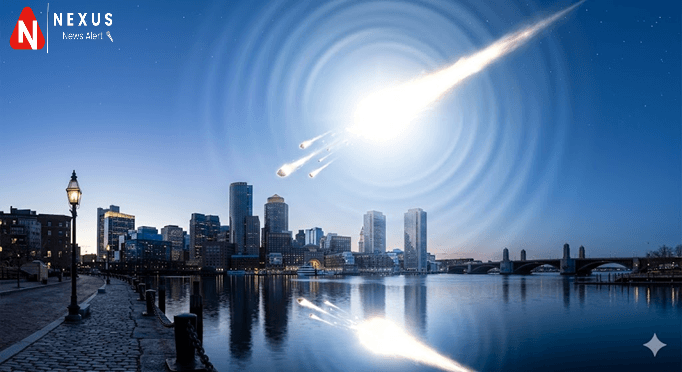
Residents along the Massachusetts–New Hampshire border were startled by a sudden, thunderous meteor sonic boom on the afternoon of May 30, 2026 . The event, witnessed by a large number of people up and down the Eastern Seaboard, was initially met with widespread speculation—ranging from earthquakes and fallen trees to even alien visitors .
After analysing imagery from weather satellites, NASA identified the culprit as a small meteor measuring roughly 3 to 5 feet (1 to 2 metres) across . Travelling at an astonishing 42,000 miles per hour (68,000 kilometres per hour), the space rock plunged into Earth's upper atmosphere . The resulting breakup released a staggering burst of energy equivalent to 300 tons of TNT .
What Happened Over Massachusetts?
The event unfolded in a matter of seconds on a Saturday afternoon. Here is the timeline of the meteor sonic boom event:
Also Read: Royal Enfield Bullet 650 Review: Top Likes and Dislikes of RE’s New 650cc Classic
The Timeline of the Meteor Event:
- Entry: The meteor, estimated to weigh approximately 5.6 metric tons, entered Earth's atmosphere at a steep angle of roughly 73 degrees .
- Friction & Heat: Friction with the increasingly dense air quickly turned the kinetic energy of the rock into intense heat.
- Fragmentation: At an altitude of roughly 40 miles (60 kilometres), the immense heat and pressure caused the meteor to fragment in a brilliant flash .
- Sonic Boom: The breakup created a powerful shockwave, or meteor sonic boom, that rattled buildings and startled residents across New England .
- Landing: While the majority of the rock vaporised, the remaining fragments of what is now classified as a meteorite rained down harmlessly into the waters of Cape Cod Bay .
The meteor travelled through the atmosphere for approximately 26 miles before falling into the bay . Witnesses reported feeling the ground shake and hearing a double boom, with some even posting that their dogs were "freaking out" from the sudden noise .
Also Read: World Brain Tumour Day 2026: Doctors Highlight Early Symptoms Many People Miss
Key Highlights of the Meteor Sonic Boom
| Aspect | Details |
|---|---|
| Date & Time | May 30, 2026, approximately 2:00 PM EDT |
| Location | Over northeastern Massachusetts and southeastern New Hampshire |
| Meteor Size | 3 to 5 feet (1 to 2 metres) in diameter |
| Speed | 42,000 mph (68,000 km/h) |
| Weight | Approximately 5.6 metric tons |
| Fragmentation Altitude | 40 miles (60 kilometres) |
| Energy Released | Equivalent to 300 tons of TNT |
| Landing Site | Cape Cod Bay, at a depth of ~100 feet |
| Composition | Likely an iron meteorite |
A Meteoric Spring: Other Recent Events
The Cape Cod fireball was the latest sighting in what experts describe as an active season of meteoritic arrivals .
Northern Europe Fireballs (March 8-11)
Observers in Northern Europe witnessed large, slow-moving fireballs. Scientists successfully recovered fragments and determined that they originated from Vesta, a massive, pristine asteroid orbiting between Mars and Jupiter .
Lake Erie Asteroid (March 17)
A 7-ton asteroid measuring roughly 6 feet across entered the atmosphere directly over Lake Erie. Travelling at 45,000 mph, it generated a brilliant daytime flash and a powerful sonic boom, releasing energy equivalent to 250 tons of TNT. NASA's trajectory data allowed meteorite hunters to recover pristine fragments in Valley City, Ohio .
Texas Fireball (March 21)
Another cosmic fragment blazed across the skies of Texas. This 3-foot-wide object travelled at 35,000 mph, releasing the energy of roughly 26 tons of TNT. Outside Houston, homeowner Sherri James was startled by a sudden crash, only to discover a 6-inch hole in her roof and a small piece of the solar system resting on her floor .
The Science Behind Sonic Booms
A sonic boom is the thunderous clap created when an object travels through the air at speeds faster than sound, which is 761 mph (1,225 km/h) .
How It Happens:
- As the meteor hurtles through the atmosphere at supersonic speeds, it pushes air molecules aside, creating a pressure wave .
- This pressure wave is similar to the wake of a boat, but in three dimensions.
- The sudden release of this pressure, often from a fragmentation event, is perceived on the ground as a loud boom .
The energy released—300 tons of TNT in this case—is a measure of the kinetic energy converted into heat and shockwaves upon atmospheric entry .
Chelyabinsk: The Modern Benchmark
The benchmark for modern atmospheric impacts is the Chelyabinsk meteor, which exploded over Russia on February 15, 2013 .
| Aspect | Chelyabinsk Meteor (2013) | Cape Cod Meteor (2026) |
|---|---|---|
| Size | 60 feet (18 metres) across | 3 to 5 feet (1-2 metres) |
| Weight | ~10,000 tons | 5.6 metric tons |
| Energy Released | 300–500 kilotons of TNT (30x Hiroshima) | 300 tons of TNT |
| Altitude of Breakup | 18 miles (29 kilometres) | 40 miles (60 kilometres) |
| Casualties | ~1,500 injured, 3,000 buildings damaged | None |
The Chelyabinsk event was a stark reminder that while Earth's atmosphere is an incredibly effective shield, a large enough kinetic punch can still reach the surface below .
Are We in Danger?
Despite these dramatic events, the chances of being directly hit by a meteorite are vanishingly small.
Statistical Odds:
According to experts, you stand a better chance of winning a multimillion-dollar lottery jackpot ten times in a row than ever being hit by a meteorite . It is more likely to be attacked by an elephant or a coyote .
The Only Confirmed Incident:
In all of recorded history, there is only one universally confirmed case of a person being directly struck by a space rock. In 1954, an 8.5-pound meteorite crashed through the roof of a house in Sylacauga, Alabama, ricocheted off a heavy wooden radio, and struck a sleeping woman named Ann Hodges . She survived with a severe bruise.
The vast majority of the tons of space debris that bombard Earth daily arrive as harmless dust grains, burning up as elegant shooting stars .
The Accidental Planetary Defence Network
In the past, such an event might have passed as an unverified sighting in the daytime sky. Today, however, our planet is wired with an accidental network of planetary defence sensors: dashboard cameras, security systems, and digital doorbells .
Because meteor entries like this one last only a few fleeting seconds, they were easily missed in the past. Now, our collective digital eyes capture these spontaneous cosmic intrusions almost instantly, bringing the universe directly into our daily news feeds .
How to Report a Fireball Sighting
If you ever happen to witness one of these magnificent fireballs ripping open the sky, consider reporting your observation to the American Meteor Society . The organisation keeps track of sightings and falls from around the globe. Recovered fragments provide a way for scientists to gain valuable information about the origin of our solar system, and of our home planet .
Conclusion
The meteor sonic boom over Massachusetts on May 30, 2026, was a dramatic reminder that we live in an active and dynamic universe. While the event startled residents and released the energy equivalent of 300 tons of TNT, it also showcased Earth's powerful atmospheric shield and the growing network of digital eyes that help us monitor our cosmic neighbourhood.
The Cape Cod event is just one in a series of recent fireball sightings, including impactful events over Lake Erie and Texas. With each new observation, scientists gain valuable insights into the origins of our solar system. As NASA confirmed, the meteor likely fragmented and fell into Cape Cod Bay, posing no threat to the public, but serving as a compelling story of our planet's connection to the cosmos .
FAQ Section
Q1: What caused the sonic boom over Massachusetts?
A1: The sonic boom was caused by a small meteor measuring 3 to 5 feet across that entered Earth's atmosphere at 42,000 mph and fragmented 40 miles above the ground .
Q2: How much energy did the meteor release?
A2: The meteor's breakup released energy equivalent to approximately 300 tons of TNT .
Q3: Did any fragments hit the ground?
A3: While most of the meteor vaporised, remaining fragments fell into Cape Cod Bay at a depth of about 100 feet . No injuries or property damage were reported .
Q4: How does this compare to the Chelyabinsk meteor?
A4: The Chelyabinsk meteor of 2013 was significantly larger (60 feet across) and released 30 times more energy. It injured about 1,500 people and damaged 3,000 buildings .
Q5: How often do these meteor events occur?
A5: While dramatic, these events are more common than most people imagine . However, they often occur over the ocean or unpopulated areas, or during the daytime, making them difficult to spot .