


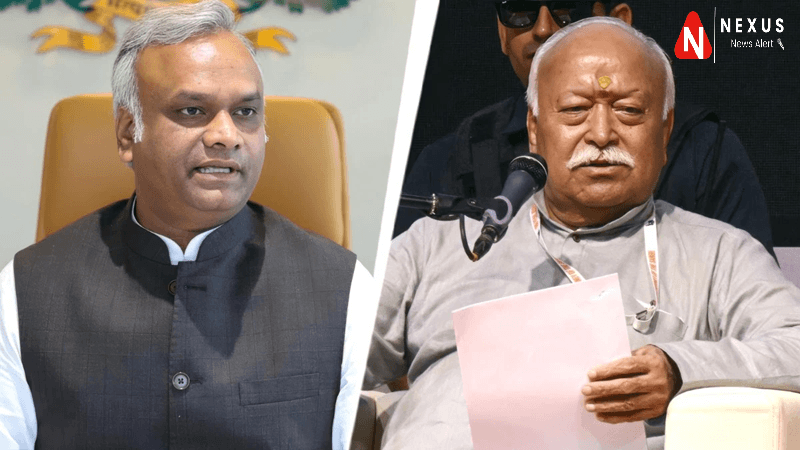
RSS chief Mohan Bhagwat has dismissed Karnataka home minister Priyank Kharge’s open letter demanding the Rashtriya Swayamsevak Sangh (RSS) register itself and publicly disclose its finances. Calling the controversy “politics”, Bhagwat argued that many long‑standing traditions and institutions function without formal registration and insisted that the Sangh is neither secretive nor illegal.
Background: What sparked the latest RSS–Kharge face‑off?
The latest exchange began when Priyank Kharge wrote an open letter to Mohan Bhagwat on the occasion of the RSS completing 100 years. In the letter, Kharge congratulated the organisation but also questioned its legal status and financial transparency.
He asked the RSS to:
- Clarify whether it is formally registered under any Indian law.
- Disclose its sources of funding, income, expenditure and assets.
- Operate with the same transparency and accountability expected from other large organisations in a constitutional democracy.
Kharge argued that an organisation claiming thousands of shakhas and crores of swayamsevaks cannot stay outside a clear legal and financial framework.
Also Read: World Brain Tumour Day 2026: Doctors Highlight Early Symptoms Many People Miss
Bhagwat’s response: ‘Many things are not registered, Hindu Dharma is not registered’
No obligation to respond formally
Responding to questions from the media, Mohan Bhagwat said he did not feel the need to formally reply to Kharge’s open letter. According to him, the demand to register the RSS and to treat it like a corporate or NGO entity is driven more by politics than by a genuine legal requirement.
He stressed that the Sangh has faced similar attacks and restrictions in the past, including government bans which were later lifted. In his view, this history itself proves that the state recognises the existence of the RSS and has engaged with it as an active organisation for decades.
‘Hindu Dharma is not registered’
Bhagwat’s most quoted line from this episode is his remark that “Hindu Dharma is not registered”. By this, he sought to underline that social, cultural and religious legitimacy do not always depend on formal registration documents.
He argued that:
- Many traditions, faiths and community practices are not registered entities.
- Registration is typically needed by those who seek government funding or certain types of institutional benefits.
- The RSS does not depend on such funding and works primarily through volunteers and public support.
Using this logic, Bhagwat suggested that insisting on formal registration for the RSS is a way to create a new political controversy, not a necessary step for legality or transparency.
Is the RSS secretive? Bhagwat says ‘No’
Visible shakhas and local workers
One of the key accusations often made against the RSS is that it operates as a secretive force behind the scenes. Bhagwat directly rejected this description, saying that the organisation’s daily activities are fully visible in public.
He pointed out that:
- RSS shakhas take place in open grounds, not behind closed doors.
- Swayamsevaks live in ordinary neighbourhoods and are part of local communities.
- Public programmes, marches and events are held regularly and openly.
From his perspective, a network that functions in broad daylight, with identifiable workers and routine community events, cannot honestly be described as underground or hidden.
Politics vs perception
According to Bhagwat, the narrative that the RSS is secretive is itself a political tool. He claimed that such labels are used to:
- Create suspicion in the minds of people who may not directly know the organisation.
- Question the Sangh’s legitimacy without engaging with its actual work on the ground.
He argued that those who interact with swayamsevaks in their local areas already know what the RSS does, making it harder to sustain the image of a hidden, shadowy institution.
Priyank Kharge’s demands: registration, finances and accountability
Legal status and registration
In his letter, Priyank Kharge focused strongly on the legal status of the RSS. He asked Bhagwat to clarify under which law, if any, the organisation is registered and who are its legally recognised office‑bearers.
Key questions raised include:
- Is the RSS registered as a society, trust, company, or any other legal entity?
- Who is authorised to represent the organisation in legal and financial matters?
- How does such a large body operate without a clearly defined legal identity?
Financial disclosure and taxes
Kharge also pressed for financial transparency. He asked the RSS to:
- Disclose its sources of funds, including donations and contributions.
- Make public its expenditure pattern and asset holdings.
- Confirm that all applicable taxes are being paid.
He framed these demands as part of constitutional responsibility, arguing that a powerful nationwide organisation should meet the same standards of openness that it expects from others.
Use of the centenary as a moment of reflection
The Karnataka minister suggested that the RSS’s 100th year should be more than a milestone celebration. In his view, it is an opportunity for “constitutional reflection” where the organisation could choose to:
- Register itself formally.
- Publish details of its internal structure and decision‑making bodies.
- Commit to ongoing financial transparency.
This, he argued, would be the best tribute the organisation could offer the country in its centenary year.
Key facts at a glance
| Point | Mohan Bhagwat’s Position | Priyank Kharge’s Position |
|---|---|---|
| Need for registration | Not necessary; many traditions and institutions aren’t registered | Essential for legal clarity and accountability |
| “Hindu Dharma is not registered” line | Used to argue that lack of registration does not erase legitimacy | Seen as insufficient in a modern constitutional democracy |
| Financial transparency | Says attacks are political; does not promise new disclosures | Demands full disclosure of funding, income, expenditure and assets |
| Nature of the debate | Primarily political, not legal | Constitutional, legal and ethical responsibility of a large organisation |
| View on secrecy | Denies secrecy; points to open shakhas and public programmes | Argues that lack of formal status and data raises questions in public mind |
What this means for the RSS at 100 years
The clash between Mohan Bhagwat and Priyank Kharge has turned the RSS’s centenary into a wider debate about the role and responsibilities of large cultural organisations in India’s democracy.
Important implications include:
- Public perception: Bhagwat’s stance may reassure existing supporters but may not fully answer critics who want documented transparency.
- Political narrative: Opposition parties are likely to keep using the registration and finance issue to pressure the Sangh and, by extension, the BJP.
- Future pressure: As the RSS grows in scale and influence, calls for it to operate within a clearly visible legal and financial framework are likely to intensify.
For now, the RSS chief has firmly indicated that he views these questions as politically motivated and not as grounds for a change in structure. Whether the organisation eventually chooses to alter its legal status or disclosure practices will be closely watched.
FAQs: Mohan Bhagwat’s ‘Hindu Dharma is not registered’ remark
1. What did Mohan Bhagwat mean by “Hindu Dharma is not registered”?
Mohan Bhagwat used the phrase “Hindu Dharma is not registered” to highlight that many long‑standing religious and cultural traditions function without being registered under modern legal frameworks. His basic point was that lack of registration does not automatically make a faith or organisation illegitimate.
2. Why did Priyank Kharge write an open letter to the RSS chief?
Priyank Kharge wrote an open letter to Mohan Bhagwat on the RSS’s centenary, asking the organisation to clarify its legal status, register itself formally, and publicly disclose its finances, assets and sources of funding. He argued that a large organisation operating nationwide should meet high standards of transparency and accountability.
3. Is the RSS currently registered as a legal entity?
That is precisely one of the questions raised by Priyank Kharge. Mohan Bhagwat has not publicly announced any new registration step in response to the letter, and instead emphasised that registration is not necessary for the RSS to function as a social and cultural organisation.
4. Why does Bhagwat call the debate ‘political’?
Bhagwat believes that the demand for registration and financial disclosure is being used as a political weapon to attack the RSS. He says the organisation has faced similar attempts and even government bans in the past, and that these moves are aimed at weakening its work rather than genuinely improving transparency.
5. Is the RSS secretive?
According to Mohan Bhagwat, no. He argues that the RSS is visible in everyday life through open shakhas, public programmes and local swayamsevaks. Critics, however, say that without a clear legal structure and financial data in the public domain, key aspects of the organisation remain opaque.