


NexusNewsAlert Markets Desk | Monday, March 23, 2026 - LIVE Updates
Indian stock markets witnessed a brutal sell-off on Monday, March 23, 2026, with the Sensex crashing 1,710 points (2.29%) and the Nifty 50 plunging below the critical 22,600 level, dragged down by escalating geopolitical tensions as US President Donald Trump issued a stark ultimatum to Iran. By 11:00 AM IST, the Sensex was trading at 72,660.20 (down 1,872.76 points or 2.51%), while the Nifty stood at 22,520.05 (down 594.45 points or 2.57%).
The bloodbath came despite Friday's modest recovery, with 46 out of 50 Nifty stocks plunging at the opening bell. Adding to investor woes, the Indian Rupee crashed past ₹94 against the US dollar for the first time in history, marking a fresh all-time low as capital flight intensified amid deteriorating risk appetite.
Key Market Highlights (As of 11:00 AM IST, March 23, 2026)
Index Performance
| Index | Current Level | Change (Points) | Change (%) | Previous Close |
|---|---|---|---|---|
| Sensex | 72,660.20 | -1,872.76 | -2.51% | 74,532.96 |
| Nifty 50 | 22,520.05 | -594.45 | -2.57% | 23,114.50 |
| Nifty Bank | Not disclosed | Sharp decline | -2.8%+ | Pressure on banks |
| Nifty Metal | Worst performer | Heavy losses | -4%+ | Commodity selloff |
Market Breadth: Overwhelmingly negative
- BSE Advance-Decline Ratio: 5:45 (only 1 in 10 stocks rising)
- Nifty Advance-Decline: 4 stocks up, 46 stocks down
Rupee Collapse
- Indian Rupee: ₹93.86 at open, breached ₹94 intraday
- All-time low: Fresh record low surpassing previous ₹93.53
- Decline: 33 paise from Friday's close
- USDINR Futures: 93.9425 (NSE data)
What Triggered Today's Crash?
1. Trump's Iran Ultimatum Dashes Peace Hopes
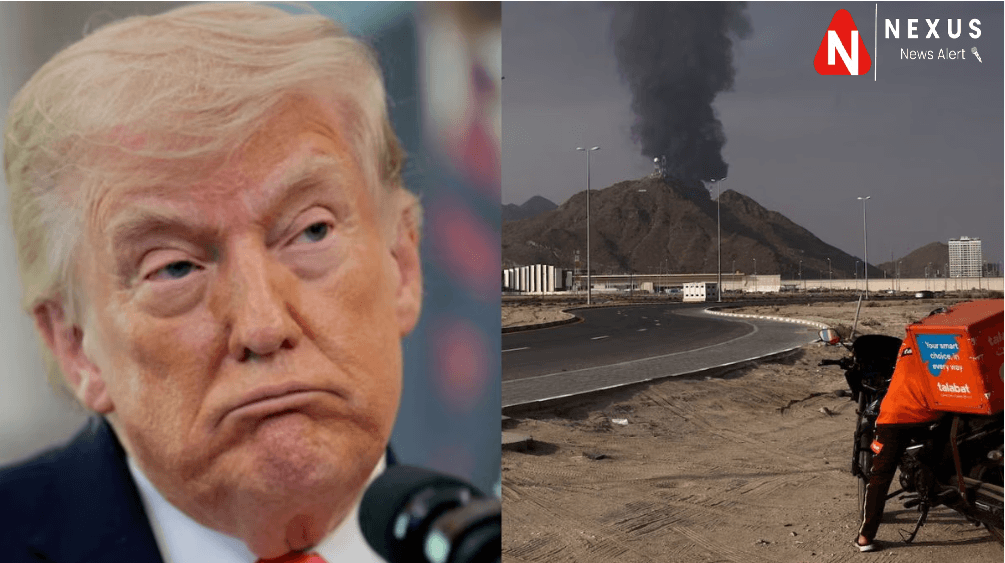
The primary catalyst was US President Donald Trump's latest threat to attack Iran's power plants if the country does not immediately reopen the Strait of Hormuz. Speaking to reporters late Sunday, Trump stated:
"Iran has 48 hours to open the Strait. If they don't comply, we will target their electricity grid and they will be sent back to the Stone Age."
This escalation dashed investor hopes for an early resolution to the month-long Iran-US conflict, which has already:
- Disrupted 20% of global oil supply
- Destroyed Qatar's LNG infrastructure (17% export capacity offline)
- Sent Brent crude above $107 per barrel (after briefly hitting $119 last Thursday)
2. Global Market Meltdown
Asian markets opened in freefall:
Japan: Nikkei 225 crashed 2,002.53 points (-3.75%) to 51,370 Hong Kong: Hang Seng plunged 859.32 points (-3.41%) South Korea: Kospi fell 329.17 points (-3.2%) China: Shanghai Composite down 2.1%
European markets on Friday had already signaled weakness, with key indices falling over 1%, setting a bearish tone for Monday's Asian session.
3. FII Selling Continues
Foreign Institutional Investors (FIIs) extended their selling streak, offloading equities worth ₹5,518.39 crore on March 20. While Domestic Institutional Investors (DIIs) offset this with purchases of ₹5,706.23 crore, the sustained FII exodus is eroding investor confidence.
4. Gift Nifty Signals
Gift Nifty, the early indicator for Nifty 50, opened with a steep dip of 386.5 points at 22,750, signaling the bloodbath ahead.
Sectoral Performance: Metal Stocks Lead Decline
Worst Performing Sectors
1. Nifty Metal Index: Down 4%+ The worst-hit sector as commodity prices crashed on recession fears:
- JSW Steel: Top loser, down over 4%
- Tata Steel: Plunged 3.8%
- Hindalco: Fell 3.5%
- Vedanta: Down 3.2%
2. PSU Bank Index: Down 3.5%+ Public sector banks suffered heavy selling:
- State Bank of India (SBI): Down 3.1%
- Bank of Baroda: Fell 3.4%
- Punjab National Bank: Down 2.9%
3. Private Banks: HDFC Bank at Fresh 52-Week Low HDFC Bank crashed to a fresh 52-week low of ₹756.60, falling 3% intraday after reports emerged that the bank asked three executives to step down over allegations of misselling (detailed below).
Top Losers (Nifty 50)
| Stock | Price | Change (%) | Reason |
|---|---|---|---|
| Shriram Finance | ₹1,245 | -4.5% | NBFC selloff |
| InterGlobe Aviation (IndiGo) | ₹3,180 | -4.2% | Oil price spike hurts airlines |
| JSW Steel | ₹850 | -4.0% | Metal sector crash |
| HDFC Bank | ₹756.60 | -3.5% | Misselling scandal + Chakraborty exit |
| Axis Bank | ₹1,032 | -3.2% | Banking sector weakness |
Top Gainers (Nifty 50) - Only 4 Stocks in Green
| Stock | Price | Change (%) | Reason |
|---|---|---|---|
| TCS | ₹4,250 | +0.8% | Defensive IT play |
| Infosys | ₹1,895 | +0.5% | Safe-haven tech stock |
| HCL Tech | ₹1,680 | +0.3% | IT resilience |
| Wipro | ₹580 | +0.2% | Marginal IT strength |
Note: IT stocks outperformed as investors sought safety in defensive sectors.
HDFC Bank Scandal: Misselling Allegations Rock India's Largest Private Bank
Three Executives Asked to Step Down
HDFC Bank, which already faced turmoil after part-time chairman Atanu Chakraborty's shocking resignation last week citing "ethical concerns," is now engulfed in a fresh controversy.
Reports (Business Standard, Economic Times) indicate the bank has asked three senior executives to step down over allegations of misselling financial products to customers. Details remain scarce, but sources suggest the products involved may include:
- Insurance policies (mis-sold as pure investment products)
- Mutual fund schemes (sold without proper risk disclosure)
- Credit cards (issued without customer consent or awareness)
Market Impact
The HDFC Bank share price fell 3.5% to hit a fresh 52-week low of ₹756.60. The stock has now crashed 15.6% from its January 2026 peak of ₹896.
Given HDFC Bank's 11% weightage in the Nifty 50, its decline alone dragged the index down by approximately 65-70 points.
Regulatory Scrutiny Expected
Analysts expect the Reserve Bank of India (RBI) to launch investigations into the misselling allegations. If found guilty, HDFC Bank could face:
- Monetary penalties (₹100-500 crore range)
- Business restrictions (temporary ban on new credit card issuance, for example)
- Reputational damage affecting deposit growth
Jaiprakash Power Ventures Tanks 10%, Associates Suspended
JPower Shares Hit Circuit
Jaiprakash Power Ventures shares crashed 10% intraday to hit a lower circuit at ₹14.72 per share on the BSE. By 10:58 AM, the stock was trading 9.11% lower at ₹14.87.
Meanwhile, Jaiprakash Associates shares were suspended due to procedural reasons (BSE did not immediately clarify the specific reason).
The selling in JP Group companies comes amid:
- Debt concerns (₹28,000+ crore debt across group companies)
- Weak project execution in infrastructure and real estate
- Regulatory scrutiny over related-party transactions
IPO Corner: Innovision Debut Disappoints
Negative Listing on March 23
Innovision, a manpower and toll plaza management services provider, made a negative debut on the bourses on Monday following the completion of its initial public offering (IPO) through which it raised ₹319.25 crore.
Listing Price: Below issue price (exact listing price awaited) Issue Price: ₹45-48 per share range Subscription: 1.2x overall (modest response)
The weak listing reflects:
- Bearish market sentiment (indices down 2.5%)
- Cautious investor appetite for small/mid-cap IPOs
- Overvaluation concerns (PE ratio appeared stretched)
Other IPOs in Focus
1. Speciality Medicines IPO (Day 2)
- First-day subscription: 0.84 times (weak)
- Aim: Raise ₹29.14 crore
- Closes: March 24
2. Tipco India Engineering IPO (Opening Monday)
- Size: ₹60.6 crore
- Opens: March 23
- Closes: Wednesday, March 25
Rupee at ₹94: Currency Crisis Deepens
Historic Low Breached
The Indian Rupee crashed past the psychologically critical ₹94 per USD mark in Monday's session, marking a fresh all-time low and reflecting:
1. Dollar Strength: US Dollar Index remains elevated as global investors flee to safety
2. Oil Price Pressure: India imports 85% of crude oil. With Brent at $107/barrel, the monthly oil import bill has surged by $3-4 billion compared to pre-war levels.
3. FII Outflows: Foreign investors pulling capital out of India due to:
- Geopolitical uncertainty
- Better returns in US bonds (5% yield)
- Currency depreciation fears
4. RBI Intervention Limited: The Reserve Bank of India has limited firepower to defend the rupee, having already spent $40+ billion in forex reserves defending the currency since February.
Economic Impact
₹94 per USD means:
- Imported inflation: Higher prices for electronics, chemicals, gold
- Costlier education/travel: Students and travelers pay more
- Pressure on fiscal deficit: Government's dollar-denominated debt servicing becomes expensive
- Corporate stress: Companies with unhedged foreign loans face losses
Expert Analysis: What Happens Next?
Bull Case: Oversold Bounce Likely
V.K. Vijayakumar, Chief Investment Strategist, Geojit Financial Services:
"The market is oversold. Historically, sharp 2-3% declines are followed by relief rallies. If oil stabilizes around $100-105, we could see a 1-2% bounce by week's end."
Positive Triggers to Watch:
- Any ceasefire talks between US and Iran
- Oil price retreat below $100/barrel
- DII buying support continuing
Bear Case: More Pain Ahead
Ajay Bagga, Market Expert:
"We are in uncharted territory. A war-induced recession is very different from a financial crisis. Until the Strait of Hormuz reopens, markets will remain under pressure. Nifty 22,000 is not out of the question."
Negative Triggers:
- Further escalation in Iran war
- Oil above $120 sustained
- Rupee past ₹95
- Earnings downgrades (Q4 results season starts April)
Support and Resistance Levels
Nifty 50:
- Immediate Support: 22,500 (tested today)
- Major Support: 22,000 (200-day moving average)
- Critical Support: 21,500 (panic level)
- Resistance: 23,000 → 23,500
Sensex:
- Immediate Support: 72,500
- Major Support: 70,000
- Resistance: 74,000 → 75,000
Global Market Snapshot (March 23, 2026)
Asian Markets
| Market | Index | Change | Percentage |
|---|---|---|---|
| Japan | Nikkei 225 | -2,002.53 | -3.75% |
| Hong Kong | Hang Seng | -859.32 | -3.41% |
| South Korea | Kospi | -329.17 | -3.20% |
| China | Shanghai | -68 points | -2.10% |
Commodities
Brent Crude: $107.20/barrel (-1.5% from Thursday's $119 peak) Gold: $5,180/ounce (+0.8% as safe-haven demand rises) Silver: $29.50/ounce (+1.2%)
What Should Investors Do?
For Long-Term Investors
1. Don't Panic Sell
- Markets have historically recovered from geopolitical crises
- Gulf War (1990-91): Sensex recovered within 6 months
- COVID crash (March 2020): V-shaped recovery
2. Accumulate Quality Stocks
- IT: TCS, Infosys (defensive, dollar earners)
- FMCG: HUL, ITC (recession-proof)
- Pharma: Sun Pharma, Dr. Reddy's (stable demand)
3. Avoid Highly Leveraged Stocks
- Stay away from companies with debt-to-equity > 1.5
- Avoid commodity stocks (metals, oil) until stabilization
For Traders
1. Hedge Positions
- Buy Nifty put options (22,500 PE, 22,000 PE)
- Consider inverse ETFs if available
2. Wait for Confirmation
- Don't try to catch a falling knife
- Wait for 2 consecutive green days before going long
3. Set Stop-Losses
- Trail stop-losses at 2-3% below entry for existing longs
Frequently Asked Questions
Q1: Will the market crash further?
Depends on geopolitical developments. If Iran-US tensions escalate and oil crosses $120 sustained, Nifty could test 22,000 or even 21,500. However, any ceasefire talks would trigger a sharp rally.
Q2: Should I invest now or wait?
For lump-sum investors: Wait for stabilization. For SIP investors: Continue your systematic investments—market timing rarely works.
Q3: Which sectors to buy in this crash?
Defensive sectors: IT, Pharma, FMCG. Avoid: Banks (until clarity on NPA impact), Metals (recession fears), Auto (oil price impact).
Q4: Is this worse than the 2008 or 2020 crash?
Not yet. 2008 saw Sensex fall 60% peak-to-trough. COVID crash saw 38% decline. Current decline is 8-10% from recent highs. However, if war escalates, it could match those levels.
Q5: What happens if rupee crosses ₹95?
Imported inflation would spike, RBI may be forced to hike interest rates (contrary to current rate-cut expectations), and FII selling could intensify. Government may impose capital controls in extreme scenarios.
Q6: When will markets recover?
Historical recovery timelines:
- Gulf War (1990-91): 6 months
- Dot-com bubble (2000-01): 3 years
- Global Financial Crisis (2008): 18 months
- COVID-19 (2020): 5 months
This war's duration is unpredictable, but markets typically recover 3-12 months after geopolitical shocks end.
Related Market News
📌 Read on NexusNewsAlert:
Live Updates: This article will be updated throughout the trading day as market developments unfold. Bookmark this page for latest updates.