


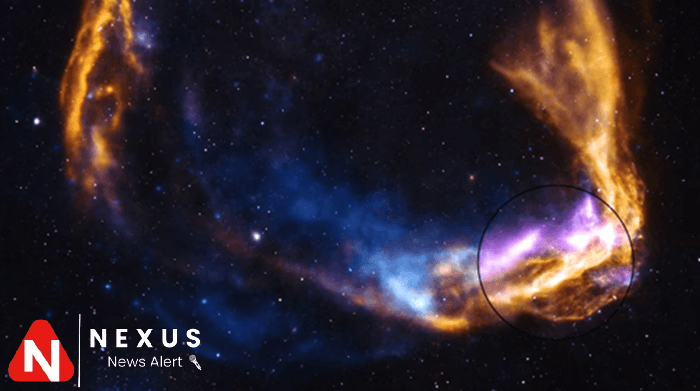
NASA supernova RCW 86 hidden bubble has just given astronomers one of the coolest cosmic plot twists in years. Nearly 2,000 years after a brilliant “guest star” lit up Earth’s skies, NASA’s powerful X-ray eyes have spotted a giant low-density cavity where the explosion happened. And now? The shockwave is literally bouncing back off the bubble’s edge like a cosmic boomerang.
This fresh discovery, made using NASA’s Imaging X-ray Polarimetry Explorer (IXPE) along with Chandra and XMM-Newton, is rewriting what we thought we knew about how supernovae evolve. At Nexus News Alert, we break it down simply, clearly, and with all the latest details so you don’t miss a single stellar moment.
The Ancient Explosion That Still Has Secrets
Back in 185 AD, Chinese skywatchers recorded a bright new star that stayed visible for months. Today, scientists identify that event as the supernova RCW 86 – a Type Ia explosion roughly 8,000 light-years away in the constellation Circinus.
For centuries, the remnant looked like a fairly normal expanding shell of gas and dust. But when NASA turned its X-ray telescopes toward it, something didn’t add up. The debris had raced outward much faster and farther than expected for a normal supernova. Why? Because RCW 86 didn’t explode in ordinary space – it blew up inside a giant low-density bubble.
NASA’s X-Ray Dream Team Reveals the Hidden Bubble
NASA supernova RCW 86 hidden bubble discovery came alive when scientists combined three powerful observatories:
- IXPE – NASA’s brand-new polarimetry explorer that measures the direction and strength of X-rays
- Chandra X-ray Observatory – the veteran that first spotted the strange cavity
- ESA’s XMM-Newton – adding extra high-energy detail
The result? A stunning multi-colour image where low-energy X-rays glow yellow and high-energy ones shine blue. The outer rim, highlighted in vivid purple, shows exactly where the action is happening right now.
The Cosmic “Bubble” That Changed Everything
Imagine blowing up a balloon inside an empty room instead of a crowded cupboard. That’s what happened here. The star that created RCW 86 had probably cleared out a huge, low-density cavity (the hidden bubble) with its stellar winds long before the final explosion.
When the supernova went off inside this empty pocket, the blast wave shot outward super-fast – almost like running on an open football field instead of pushing through thick forest. That’s why the remnant looks bigger and more lopsided than other 2,000-year-old supernovae.
Shockwave Rebound: The “Bouncing Back” Moment Scientists Love
Here’s the most exciting part of the NASA supernova RCW 86 hidden bubble story. The expanding shockwave finally slammed into the dense wall of the bubble and reflected back inward – creating what astronomers call a “reflected shock.”
It’s exactly like an ocean wave crashing against a harbour wall and bouncing back. This rebound is now lighting up new regions with fresh X-ray energy, and IXPE has captured the precise polarisation patterns that prove it’s happening.
Scientists say this reflected shock is giving the remnant a whole new lease of life, even after two millennia.
Key Facts About RCW 86 Supernova Remnant at a Glance
| Fact | Details |
|---|---|
| Age of explosion | Around 185 AD (nearly 2,000 years ago) |
| Distance from Earth | Approximately 8,000 light-years |
| Type | Type Ia supernova |
| Special environment | Exploded inside a giant low-density bubble |
| Current size | Much larger and faster-expanding than expected |
| Latest observation | Reflected shock wave “bouncing back” |
| Telescopes used | IXPE + Chandra + XMM-Newton |
| Why it matters | Shows how surroundings shape supernova evolution |
This simple table sums up why the NASA supernova RCW 86 hidden bubble is such a big deal for space science.
Also Read : “2026 Is the New 2016”: Why Millions Are Flooding Social
Why This Discovery Is Blowing Astronomers’ Minds
Most supernovae studies assume explosions happen in pretty average space. But RCW 86 proves the surroundings can completely change the story – speed, shape, energy release, everything.
Understanding these hidden bubbles helps scientists better model how heavy elements spread across the galaxy, how cosmic rays are accelerated, and even how future supernovae might behave near us. It’s a reminder that the universe still has surprises after billions of years.
What This Means for Everyday Space Fans
You don’t need to be a rocket scientist to appreciate this. Every time NASA reveals something like the NASA supernova RCW 86 hidden bubble, it shows how modern telescopes can turn ancient history into living science. The light we see today left the explosion when the Roman Empire was still going strong – yet we’re only now understanding its final chapter.
FAQ: Your Burning Questions on NASA Supernova RCW 86 Hidden Bubble Answered
Q1: What exactly is the “hidden bubble” in RCW 86?
It’s a giant low-density cavity in space that the star cleared out before exploding. The supernova blast expanded much faster inside this empty pocket.
Q2: How did NASA spot the bouncing-back shockwave?
Using the new IXPE telescope plus Chandra and XMM-Newton. The polarimetry data clearly shows X-rays reflecting off the bubble’s edge.
Q3: When did the original supernova happen?
Around 185 AD – almost 2,000 years ago. Ancient Chinese astronomers recorded it as a bright “guest star.”
Q4: Is RCW 86 dangerous for Earth?
Not at all. It’s 8,000 light-years away. The explosion’s light reached us long ago; we’re just studying the leftover glow now.
Q5: What type of supernova was it?
A Type Ia – the kind used as “standard candles” to measure distances in the universe.
Q6: Will we see more reflected shocks in other remnants?
Astronomers are already scanning similar old supernovae. This discovery might change how we interpret many others.
Q7: Where can I see the actual images?
Head to NASA’s official galleries or bookmark Nexus News Alert – we’ll keep updating with the latest visuals and explanations.
Final Thoughts: The Universe Is Still Evolving
The NASA supernova RCW 86 hidden bubble story proves that even explosions from the time of the Roman Empire still have fresh secrets to share. With every new telescope and smarter analysis, we keep learning that space is far more dynamic – and far more surprising – than we ever imagined.
We’ll keep watching this cosmic rebound and bring you the next updates the moment they drop. For the latest space breakthroughs, bookmark Nexus News Alert and never miss a stellar discovery.