

Published by NexusNewsAlert | Culture & Social Media | March 20, 2026
The Viral Nostalgia Phenomenon Sweeping TikTok, Instagram & Twitter
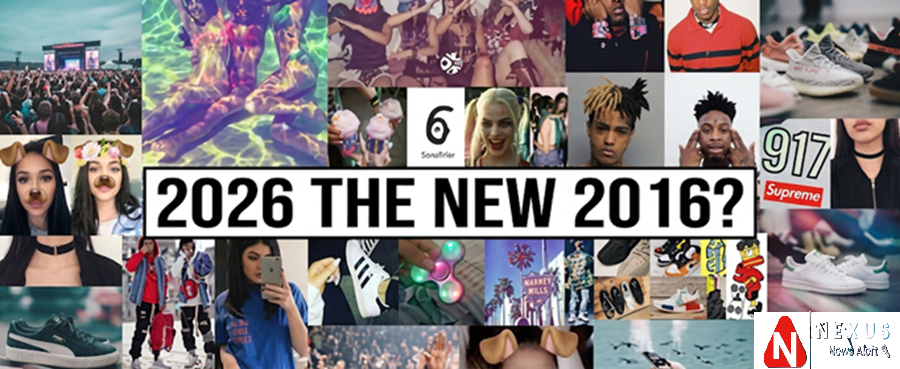
In a remarkable display of collective digital memory, social media platforms have transformed into virtual time machines as millions of users worldwide embrace the viral declaration that "2026 is the new 2016." What began as an ironic Gen-Z joke on New Year's Eve 2025 has exploded into one of the most significant cultural movements of early 2026, with over 37 million Instagram posts using the #2016 hashtag, 2.3 million TikTok videos celebrating the aesthetic, and participation from A-list celebrities including Kylie Jenner, Selena Gomez, Charlie Puth, Hailey Bieber, and Reese Witherspoon.
The trend centers on a profound yearning for what many remember as a simpler, more authentic era of the internet—before COVID-19, before AI-generated content dominated feeds, before algorithm fatigue set in. Users are unearthing grainy iPhone photos featuring oversaturated VSCO filters, iconic Snapchat dog ear and flower crown filters, açai bowl flat-lays, choker necklaces, and the vibrant, carefree energy that defined mid-2010s digital culture.
NexusNewsAlert explores why this nostalgia wave resonates so powerfully, what it reveals about our current digital discontent, and whether 2016 was truly the golden age everyone remembers—or if selective memory is romanticizing a more complicated year.
Origins: How "2026 Is the New 2016" Went Viral
TikTok User @taybrafang Sparks Movement
The phenomenon traces back to December 31, 2025, when TikTok creator @taybrafang posted a nostalgic montage of 2016 moments—Snapchat filters, VSCO-edited photos, The Chainsmokers playing in the background, and the unmistakable aesthetic of a decade ago. The video resonated immediately, capturing a sentiment that millions had been feeling but hadn't yet articulated.
Within hours, the hashtag #2016 began spreading exponentially. By January 1, 2026, the phrase "2026 is the new 2016" appeared on Instagram, TikTok, Twitter, and Facebook as users dug through decade-old camera rolls and Snapchat Memories, rediscovering forgotten photos that perfectly encapsulated the era's aesthetic.
The Great Meme Reset: A Sincere Movement
According to Forbes, the trend connects to an earlier movement called the "Great Meme Reset"—an ironic Gen-Z initiative proposing that social media users "reset" the internet by posting classic memes to drown out low-effort AI-generated engagement bait. The reset positioned 2016 as the "golden age of memes," right before the perceived decline into algorithm-dominated, influencer-driven, authenticity-depleted digital spaces.
What started as ironic humor quickly transformed into sincere nostalgia. As NBC News reports, users genuinely long for 2016's energy—a time when social media felt more personal, chronological, and carefree rather than curated, commercialized, and anxiety-inducing.
The 2016 Aesthetic: What Made It So Iconic?
VSCO Filters & Oversaturated Colors
If there's one defining visual element of 2016, it's VSCO filters—particularly presets like A6, C1, and HB2 that bathed photos in warm, oversaturated tones. Unlike today's "clean girl aesthetic" or "quiet luxury" minimalism, 2016 embraced maximum saturation. As content creator Paige Lorentzen explains:
"Now, we've gone very neutral-toned, like quiet luxury aesthetic, very minimal. Whereas back then, it was the brighter the saturation on your photos, the better. Everything felt like summer."
The result? Feeds filled with impossibly bright açai bowls, sunset-soaked beach photos, and outfit flat-lays so colorful they bordered on neon. This visual language became shorthand for a specific emotional register: optimistic, energetic, unapologetically vibrant.
Snapchat Filters: Dog Ears, Flower Crowns & Face Swap
Snapchat reigned supreme in 2016, and its filters defined the year's playful spirit. The dog filter (with floppy ears and tongue) and the flower crown filter became ubiquitous, appearing at concerts, parties, and casual selfies. Unlike today's heavily edited Instagram face filters, Snapchat's were whimsical rather than aspirational—meant for laughs with friends, not flawless presentation.
Face swap, rainbow vomit, and the Rio de Janeiro Olympic filter similarly captured 2016's "it's OK to be cringey" attitude. As creator Katrina Yip notes:
"It was OK to be cringey, you know? People were just posting for their friends. The people you followed on social media were just people you knew in real life."
Fashion: Chokers, Crop Tops & Coachella Boho
2016 fashion was equally distinctive. Key elements included:
- Choker necklaces (black velvet or tattoo-style)
- Crop tops paired with high-waisted jeans
- Flannel shirts tied around the waist
- Festival fashion: Coachella flower crowns, bohemian maxi dresses, gladiator sandals
- Kylie Jenner lip kits: matte liquid lipsticks in nude shades
- Bold eyebrows and dramatic winged eyeliner
- Adidas sneakers and athleisure domination
Brands like Boxed Water Is Better, Triangl Swimwear, Brandy Melville, and Glossier (launched in 2014 but peaked in 2016) became emblematic of the era's lifestyle branding.
Pop Culture Moments That Defined 2016
Music: The Soundtrack of a Generation
2016's music landscape shaped the nostalgia profoundly:
- "Closer" by The Chainsmokers ft. Halsey - inescapable summer anthem
- Beyoncé's "Lemonade" - cultural phenomenon and visual album revolution
- Drake's "Views" - dominated streaming with "One Dance" and "Hotline Bling"
- "Cheap Thrills" by Sia - dance floor staple
- "Lush Life" by Zara Larsson - recently resurgent via TikTok dance
- Justin Bieber's "Purpose" era - "Sorry," "Love Yourself," "What Do You Mean?"
- Frank Ocean's "Blonde" - critically acclaimed surprise drop
As journalist Leah Faye Cooper told ABC News, these songs create "an immediate emotional transport" back to the era.
Viral Trends & Internet Culture
2016 birthed internet phenomena that feel quaint compared to today's TikTok virality:
Pokémon GO - The only app that forced youth outside, creating spontaneous community gatherings. The July 2016 launch became a global phenomenon.
The Mannequin Challenge - Entire groups frozen mid-action while cameras panned through scenes, set to Rae Sremmurd's "Black Beatles."
Vine's Golden Era - Though Vine closed in January 2017, 2016 represented its creative peak, with stars like King Bach, Lele Pons, and Thomas Sanders producing six-second comedy gold.
Harambe Memes - The Cincinnati Zoo gorilla's death in May 2016 spawned controversial but ubiquitous internet humor.
Dabbing - Dance move popularized by Cam Newton and Migos, performed everywhere from school cafeterias to political rallies.
"Damn Daniel" - Viral video complimenting a teenager's white Vans, epitomizing 2016's absurdist meme culture.
Celebrity Participation Amplifies the Trend
Kylie Jenner's "King Kylie" Era
On January 15, 2026, Kylie Jenner posted throwback photos captioned "You just had to be there," generating over 2.4 million likes. The post referenced her iconic "King Kylie" phase—2016-2017 when she dominated social media with her lip kits, turquoise hair, and seemingly effortless cool-girl aesthetic.
Jenner's 2016 lip kit launch revolutionized celebrity beauty brands, selling out within seconds and establishing direct-to-consumer Instagram marketing as the industry standard. Her participation legitimized the trend, signaling that even those who defined 2016 culture feel nostalgic for it.
Other Celebrity Participants
Selena Gomez shared 2016 photos from her "Revival" tour era, reminding fans of her pop dominance that year.
Charlie Puth posted studio sessions from his "Nine Track Mind" album recording.
Hailey Bieber unearthed modeling photos from early career shoots, before marriage to Justin Bieber.
Reese Witherspoon, John Legend, Karlie Kloss, Emily Ratajkowski, and Lily Collins all joined the wave, with some sharing personal milestones (weddings, career breakthroughs) from that year.
Why 2016? The Psychology of Ten-Year Nostalgia
The Decade Milestone Effect
2026 marks exactly 10 years since 2016—a natural psychological milestone for reflection. As The New York Times notes, the internet's "gaze backward to the not-so-distant past" demonstrates the "acceleration of nostalgia online," where cultural trends "burn bright and die fast, making the landscape of just a few years ago feel like a foreign country."
Research shows humans tend to feel strongest nostalgia for experiences from roughly 10-30 years ago, explaining why millennials (now in their 30s) and older Gen-Z (early 20s) both engage passionately with 2016 content.
Pre-Pandemic Innocence
For many, 2016 represents the last "normal" year before major global disruptions:
- COVID-19 pandemic (2020-2023) upended daily life
- Trump presidency (2017-2021) intensified political polarization
- Algorithm changes on Instagram (2016 started chronological to algorithmic feeds)
- TikTok's rise (2018+) fragmented internet culture
- AI content generation (2022+) made authenticity suspect
As cultural commentators note, 2016 nostalgia reflects longing not just for a year, but for a pre-pandemic, pre-AI, pre-algorithm-exhaustion internet when posting felt spontaneous rather than strategic.
Millennial Optimism Meets Gen-Z FOMO
The trend showcases an interesting generational dynamic. Millennials (born 1981-1996) actually lived 2016 as young adults—attending Coachella, launching careers, experiencing peak Silicon Valley optimism. They post throwbacks from genuine memory.
Gen-Z (born 1997-2012) were children or young teens in 2016—old enough to remember the memes and music but too young to fully participate in the nightlife, festival culture, and freedom the year symbolizes. As Fortune Magazine observes:
"For those now juggling college debt, precarious work, and a cost-of-living crisis, the grainy clips of suburban parking lots, festival wristbands, and crowded Ubers feel like evidence of a slightly easier universe that just slipped out of reach."
Gen-Z drives the trend's virality while processing "a basic unfairness: they inherited the platforms without the perks."
The Economic Subtext: What Gen-Z Lost
The Decline of the "Cheap Internet"
Fortune's analysis reveals a crucial economic dimension to 2016 nostalgia. In 2016, venture-capital-subsidized services made urban life remarkably affordable for young people:
- Uber/Lyft rides cost half today's prices (pre-profitability pressure)
- Food delivery was underpriced (DoorDash, Uber Eats burning cash for market share)
- Streaming services were bundled affordably (Netflix $9.99, no password-sharing crackdowns)
- Social media was chronological and free of aggressive monetization
By 2026, these same services have become expensive, algorithm-driven, and profit-optimized. Gen-Z faces:
- Student debt burdens millennials didn't experience at the same scale
- Housing unaffordability in major cities
- Gig economy precarity replacing stable entry-level jobs
- Content creator saturation making influencer income unrealistic
The "2016 vibes" trend thus functions as subtle economic protest—yearning for an era when tech platforms subsidized youth culture rather than extracting maximum value from it.
The Dark Side: What 2016 Actually Was
Selective Memory & Historical Amnesia
While the trend celebrates 2016's aesthetics, critics point out it conveniently ignores the year's significant traumas and controversies:
Political Turmoil:
- Donald Trump's election over Hillary Clinton
- Brexit referendum upending European unity
- Syrian refugee crisis peak
Violence & Tragedy:
- Pulse Nightclub shooting (Orlando) - 49 killed
- Police shootings of Alton Sterling and Philando Castile
- Brussels and Nice terrorist attacks
- Aleppo bombing and humanitarian catastrophe
Health Crises:
- Zika virus epidemic threatened Olympics
- Opioid crisis escalating deaths
As The Cut's Andrea González-Ramírez writes:
"All this Coachella-flower-crowned nostalgia elides that 2016 was chock-full of horrors, too. Even if the VSCO filters were cute, the vibes in 2016 were pretty rancid."
"Nothing Worth Concern"? A Troubling Parallel
The tendency to romanticize 2016 while ignoring its darkness mirrors how nostalgia often operates—prioritizing positive emotional associations over critical historical recall. This selective memory raises questions about how social media shapes collective memory, potentially creating ahistorical narratives that flatten complex realities into aesthetic trends.
How Brands Are Capitalizing on the Trend
Nostalgia Marketing's 75% Purchase Boost
Research shows 75% of consumers are more likely to purchase when ads evoke nostalgic memories, with 61% of millennials saying nostalgia improves brand perception. Smart brands have jumped on the 2016 wave:
Fashion label Reformation posted celebrities wearing their 2016 collections.
VSCO itself promoted #VSCOGirl throwbacks, reminding users of their app's cultural dominance.
Spotify curated "2016 Hits" playlists featuring Chainsmokers, Drake, and Rihanna.
Snapchat hinted at bringing back classic filters (though no official announcement yet).
For businesses, the trend offers opportunities to:
- Create 2016-inspired content (use VSCO editing, lowercase captions)
- Launch throwback product lines or limited editions
- Partner with millennial influencers who authentically lived the era
- Tap into emotional resonance rather than hard-sell tactics
The Trend's Scale: By the Numbers
Social Media Metrics:
- 37 million+ Instagram posts with #2016
- 2.3 million TikTok videos using #2016
- 1.6 million videos celebrating 2016 aesthetic uploaded in January 2026
- 450% increase in "2016" searches on TikTok (first week of January)
- 2.4 million likes on Kylie Jenner's throwback post alone
Celebrity Participation: Over 50 major celebrities posted 2016 throwbacks, including actors, musicians, models, and athletes across Hollywood and Bollywood.
Geographic Spread: While concentrated in the US, the trend spread to UK, Canada, Australia, India, Brazil, and Philippines, demonstrating 2016's internet culture transcended borders.
Is This Just a Fleeting Fad?
The Cyclical Nature of Nostalgia
Fashion and cultural historians note that nostalgia cycles typically operate on 20-30 year timelines—the 1990s nostalgia of the 2010s, the 1970s revival of the 1990s. The "2026 is the new 2016" trend compresses this timeline to just 10 years, suggesting nostalgia acceleration in the digital age.
Some predict the trend will fade by mid-2026 as new cultural moments capture attention. Others argue it represents a fundamental shift in how younger generations relate to internet history—viewing even recent years as archaeological artifacts worthy of excavation.
Deeper Than Filters: A Protest Against Digital Dystopia
The most compelling analyses suggest this isn't mere aesthetics but a protest movement disguised as nostalgia. Users aren't just missing VSCO filters; they're rejecting:
- AI-generated content flooding feeds
- Algorithm manipulation controlling what they see
- Influencer culture's authenticity crisis
- Platform monetization making casual posting feel like unpaid labor
- Political polarization making every post potentially controversial
By retreating to 2016, users signal: "We want an internet that feels human again."
Frequently Asked Question
Q1: What is the "2026 is the new 2016" trend?
The trend involves social media users posting throwback photos, videos, and memories from 2016, embracing the year's distinctive aesthetics (VSCO filters, Snapchat filters, festival fashion) and expressing nostalgia for what's perceived as a simpler, more authentic internet era.
Q2: Why is everyone posting 2016 content?
Multiple factors drive the trend: 2026 marks exactly 10 years since 2016 (milestone anniversary), nostalgia for pre-pandemic/pre-AI internet culture, economic frustrations with expensive modern platforms, and genuine affection for 2016's vibrant, less curated social media aesthetic.
Q3: What VSCO filters were popular in 2016?
The most iconic VSCO filters from 2016 included A6 (warm, film-like), C1 (bright and airy), HB2 (high contrast), and various presets that created oversaturated, warm-toned images that defined the era's visual language.
Q4: Which celebrities are participating in the trend?
Over 50 celebrities joined, including Kylie Jenner, Selena Gomez, Charlie Puth, Hailey Bieber, Reese Witherspoon, John Legend, Karlie Kloss, Emily Ratajkowski, Lily Collins, and Kim Kardashian, among others from Hollywood and Bollywood.
Q5: Was 2016 actually a good year?
2016 was complex—culturally vibrant with memorable music, memes, and internet trends, but politically tumultuous (Trump election, Brexit) and marked by tragedies (Pulse shooting, terror attacks, Zika epidemic). The trend romanticizes positive aspects while often overlooking darker realities.
Q6: Will this trend last beyond 2026?
Cultural experts are divided. Some view it as a fleeting nostalgia cycle that will fade within months, while others believe it represents a lasting shift in how younger generations engage with recent digital history, potentially influencing fashion, music, and internet culture for years.
Related Articles on NexusNewsAlert
📌 Read More:
- India Wins 2026 World Cup: Men in Blue
- Breaking: Pakistan Airstrike on Kabul Hospital Raises Death Toll to 400
- Salman Khan’s Battle of Galwan Retitled ‘Maatrubhumi: May War Rest
- Iran-US War Day 16: Escalating Conflict Threatens Global Oil Supply
External References
🔗 Learn More: